Foundry
The harness behind the work.
Foundry is the agentic harness we built to do the operator work — the board packs, the financial model, the investor updates, the data room — as agentic operations rather than by hand.
What Foundry is
A harness is the structure around the models, not the models themselves: the orchestration that decides which agent does which task, a knowledge layer that holds the context and intent each task needs, a permission boundary on what an agent may write, and an audit trail of every run. Foundry is ours. It assembles a board pack from numbers that reconcile, keeps the financial model current, drafts the investor update on the same date each month, and keeps the IP register moving as the licence re-papering goes through — the routines a founding team cannot resource part-time and cannot afford to wait to hire for.
It is the same substrate we build around a spinout. We run on it ourselves first because a substrate you have not run is a claim, not a tool.
What it does
Five things the harness does, in order: frame the task, deliberate on it, deliver the output, govern what ships, and learn from the run. Shared memory sits underneath all five.
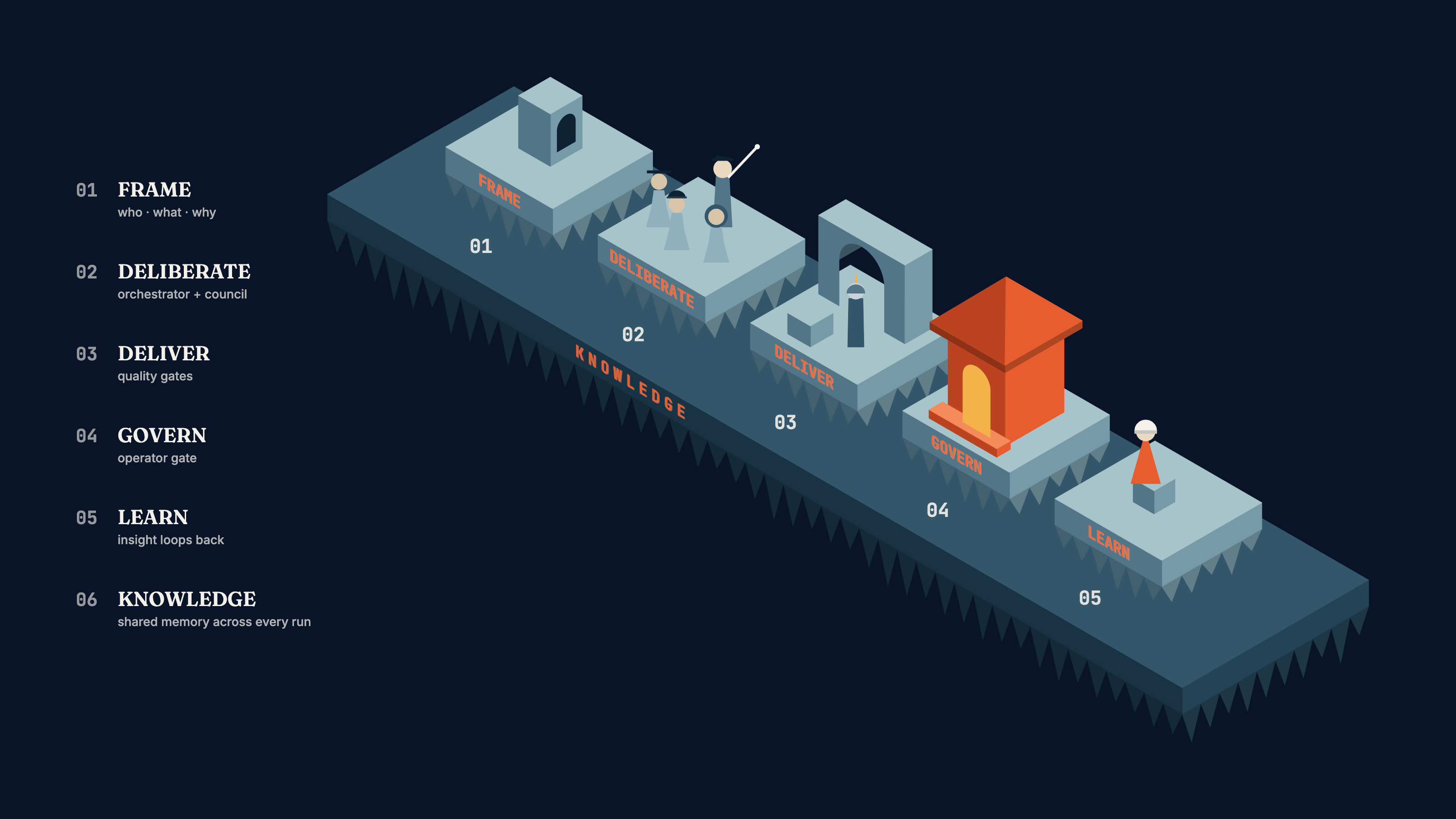
Frame
Set the task up right before any work starts.
- BriefThe who, what and why, stated explicitly.
Deliberate
Think it through from distinct expert lenses.
- OrchestratorRoutes work to the right capability; one conductor.
- Expert CouncilDistinct chairs, independent positions in parallel.
- SynthesisOne recommendation; disagreement kept in view.
- Delegation → SpecialistsSlices handed to bounded workers.
Deliver
Turn the approved answer into finished work.
- Quality GateGolden and adversarial checks; failure-recovery.
- Artefact DeliveryThe document, plan or published change.
Govern
Keep it inside the rules, with a person in command.
- Operating CharterWhat the system may do, and what good looks like.
- Safety & Authority RulesWhat runs alone, what waits for a person.
- Operator GateThe human approval point before load-bearing work ships.
Learn
Carry the lesson into the next run, and the rules.
- Learning LoopReviews completed work; distils lessons.
- Governance ReviewFeeds lessons back into the Charter, deliberately.
feeds context into frame · deliberate · deliver
Why we publish a usage trace
We keep a live, auditable record of that usage — by day, by source, and by the kind of work it went into, with exact and estimated figures kept apart. It exists to sharpen what we hand to the machine next, not as a scoreboard. If we ask a founding team to trust an operating substrate they cannot see inside, the least we can do is show our own.
The live usage trace
AI usage by day, by source, and by the kind of work it went into — built from our own tool logs, exact and estimated figures kept apart. A static page on this domain: no cookies, no third-party scripts.
The principle
We do not sell software. Foundry is how the work gets done, not a product to license. What ships for a spinout is the board pack, the model, the update — the record. Foundry is what keeps that record current; the usage trace is how we stay honest about what it costs to run.
- Built and run in-house
- No third-party tracking
- Usage trace published openly
- The work is the record
Related reading
The argument for an operating substrate, and what it is made of, is set out in Chat Plus SaaS Is No Longer Enough. Why the harness around the model matters more than the model is the subject of The Bottleneck Has Moved.
← Back to SpinUp Forge